
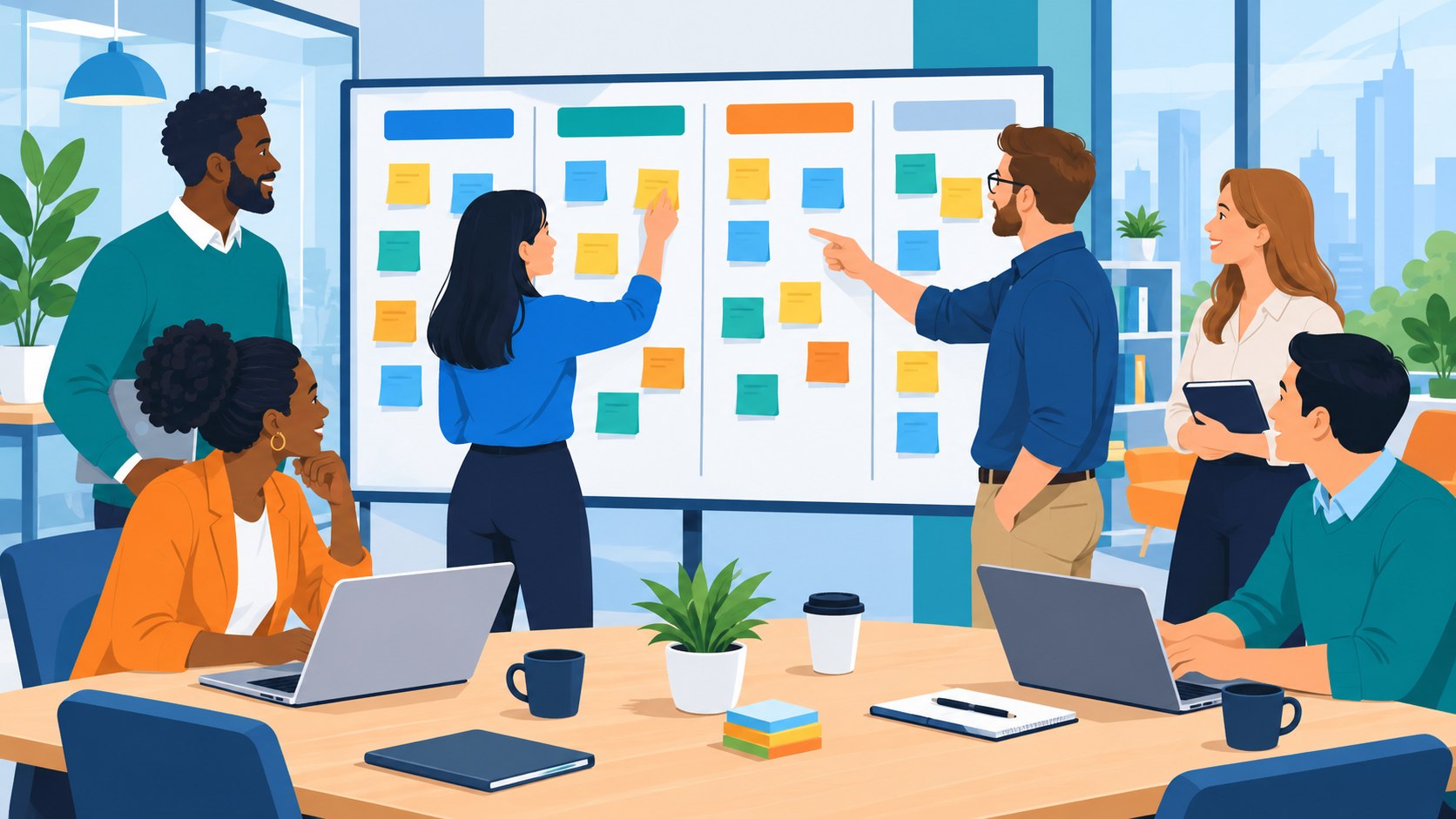
Organizations adopting Agile often narrow the choice to two frameworks: Scrum and Kanban. Both help teams deliver value iteratively and improve continuously, but they structure work in fundamentally different ways. Understanding Scrum vs Kanban – how each manages flow, roles, and planning – helps leaders pick the approach that fits their teams, or blend the two deliberately.
Two Frameworks, One Agile Mindset
Scrum and Kanban both descend from the Agile Manifesto’s values: responding to change, collaborating with customers, and delivering working results frequently. Both make work visible, and both encourage teams to inspect how they work and adapt. Neither is a complete project management methodology on its own; each is a lightweight framework that teams shape around their context. For organizations balancing enterprise delivery with regulatory or contractual obligations, both frameworks also create the visibility that oversight and status reporting depend on. That shared foundation means the choice is less about right or wrong and more about fit.
How Scrum Works
Scrum organizes work into fixed-length iterations called sprints, usually one to four weeks. The Scrum Guide defines three accountabilities – Product Owner, Scrum Master, and Developers – and a series of events: sprint planning, the daily scrum, sprint review, and the retrospective. The team commits to a sprint goal, pulls work from a prioritized product backlog, and produces a potentially releasable increment at the end of every sprint. That cadence creates a predictable rhythm for planning, feedback, and improvement.
How Kanban Works
Kanban is a flow-based method. Work items move across a visual board, typically through columns like To Do, In Progress, and Done, and the team limits how many items may be in progress at once. These work-in-progress limits expose bottlenecks quickly and keep the team focused on finishing work rather than starting it. There are no required iterations, roles, or ceremonies; Kanban is designed to layer onto an existing process and improve it gradually, which makes it easy to adopt without restructuring teams. Because every item stays visible on the board, stakeholders can see status without interrupting the team, and daily conversations can focus on blocked work instead of status recitation.
Scrum vs Kanban: The Key Differences
The practical differences come down to a few dimensions:
- Cadence: Scrum plans in fixed sprints; Kanban delivers continuously with no required timeboxes.
- Roles: Scrum defines specific accountabilities; Kanban defines none.
- Change mid-stream: Scrum discourages changes inside a sprint; Kanban lets new priorities enter as soon as capacity frees up.
- Metrics: Scrum teams often track velocity per sprint; Kanban teams track cycle time and throughput.
- Boards: A Scrum board resets each sprint; a Kanban board is a persistent picture of flow.
When Scrum Is the Better Fit
Scrum tends to work well for product teams building something new, where priorities can stay steady for a couple of weeks and stakeholders benefit from a regular review cadence. New Agile teams also gain from its structure: the defined roles, events, and timeboxes create guardrails while good habits form. If your organization wants predictable demonstrations for business sponsors or government stakeholders, Scrum’s rhythm supports that expectation directly.
When Kanban Is the Better Fit
Kanban suits work that arrives unpredictably – support queues, operations, maintenance, and service teams – where locking a sprint backlog would conflict with reality. It also fits organizations that want evolutionary change, because Kanban starts from the process you already have and lowers the disruption of adoption. Experienced teams sometimes combine the two, using Scrum’s events with Kanban’s flow management, an approach often called Scrumban.
Choosing Your Framework and Building the Skill
Start with the nature of your work: planned product increments point toward Scrum, while continuous, interrupt-driven demand points toward Kanban. Then weigh your team’s experience and your stakeholders’ expectations. Whichever framework you choose, it only delivers results when the team understands the principles behind it. Explore our Agile training programs to build those skills, or contact Learnskilz to discuss coaching for your organization’s Agile adoption.